

Exploring Employee Responses to Organizational Change at EURAM 2026
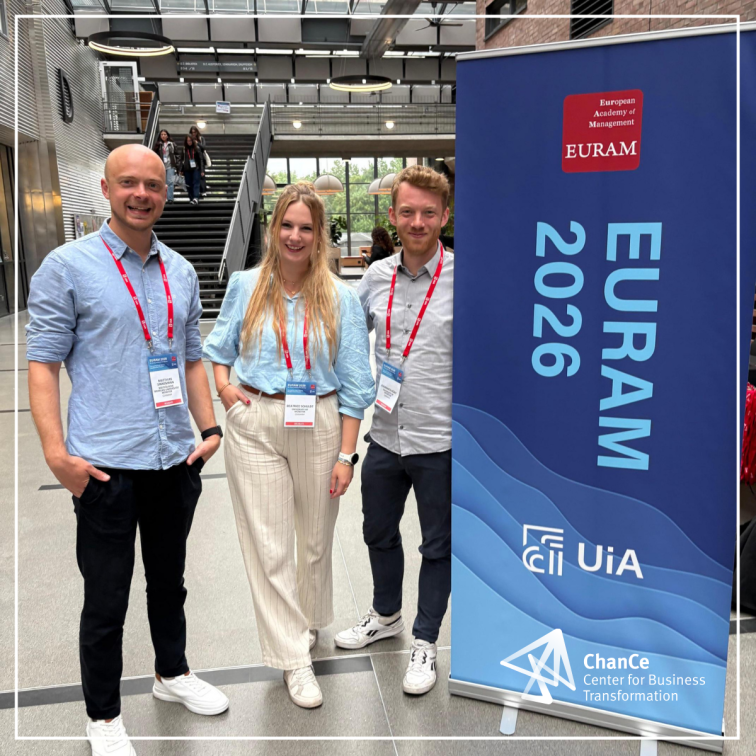
Recently, members of ChanCe participated in the EURAM 2026 Conference in Kristiansand, Norway. Under the conference theme “Navigating High Waters - Managing in an age of disruption,” researchers from across Europe came together to discuss current developments and future directions in management research.
As part of the conference, Marika Platz presented research conducted together with Julia Backmann, Matthias Sinnemann, Felix Hoch, and Johannes Hüby on how employees respond to positively perceived organizational change. Drawing on a longitudinal study of organizations that introduced a four-day workweek without salary reductions, the research examines how employees help shape and sustain organizational change over time. A key insight from the study is that employees play an active role in making organizational change successful:
- Rather than merely adapting to change, employees take ownership of new initiatives by adjusting their own work practices.
- By supporting colleagues and developing new ways of collaborating, they help embed change in everyday work and contribute to its long-term success.
- While management establishes favorable conditions at the outset, employees themselves become key drivers of change over time.
In another session, Beatrice Schult presented research on employees' preferences for high-intensity remote work, defined as employees' intention to perform a large share of their work remotely. Drawing on interviews and Qualitative Comparative Analysis, the study shows that there is no single profile of employees who prefer remote work. Instead, different combinations of personal, work-related, and contextual factors shape employees’ intentions to engage in high-intensity remote work:
- Employees develop preferences for remote work through different pathways rather than a single set of conditions.
- Family responsibilities, workplace constraints, commuting distance, and digital work environments all play an important role.
We thank the EURAM community and EURAM SIG Innovation for the discussions and feedback.