


Alumni Story: Dr. Ute Paukstadt
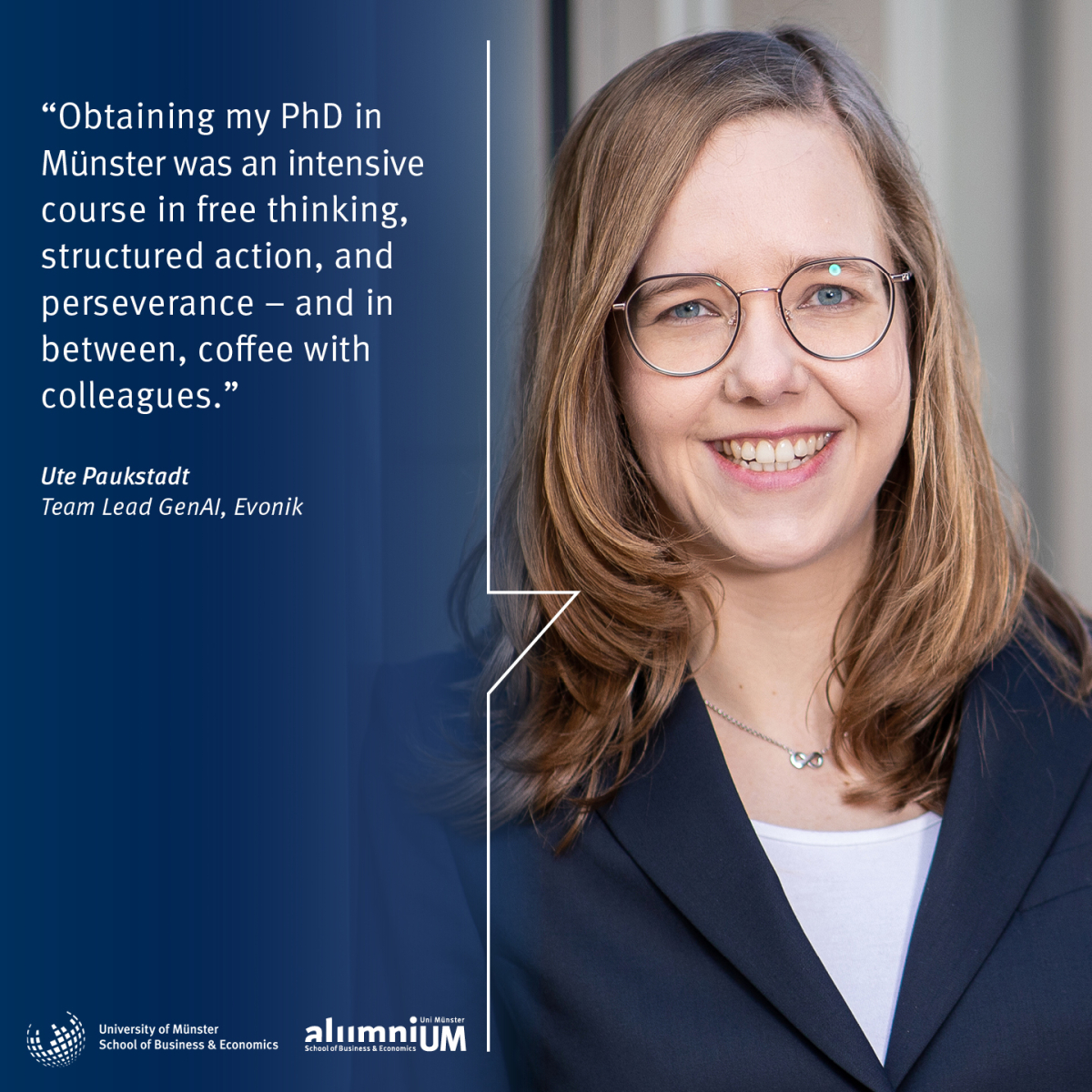
After graduation, many graduates are drawn to the corporate world. However, some remain at the School of Business & Economics as early-career researchers or join later for their doctoral studies. This was also the path chosen by Dr. Ute Paukstadt, who completed her studies at the University of Duisburg-Essen before moving to Münster to pursue her PhD in Information Systems. After completing her doctorate, Ute Paukstadt began her career outside academia as a lecturer for IT systems and IT management at the University of Applied Sciences for Police and Public Administration in North Rhine-Westphalia (HSPV NRW). At the same time, she also worked as an IT/ERP consultant. In 2021, Ute Paukstadt joined Evonik as Senior Manager Digitalization, where, from August 2022, she took on the role of IT Product Manager/Product Owner for “Digital Business” and “Generative Artificial Intelligence” (GenAI). Since April 1, 2025, Ute Paukstadt has been Team Lead for GenAI at Evonik.
In this interview, Ute Paukstadt shares insights about her doctoral studies at the University of Münster, the differences between academia and corporate life, and her current field of work at Evonik.
Dr. Paukstadt, after completing your master’s degree, you decided to pursue a PhD. How would you describe that time compared to your master’s studies and working life in a company?
The PhD was a fundamentally different experience from my Master’s studies and from working in a company. While the Master’s program offered a structured learning environment, the doctorate required a high degree of self-discipline and personal responsibility. I worked largely independently on my research project, which demanded a completely different mindset and approach to problem-solving. Academic work was strongly focused on writing publications and applying scientific methods systematically to generate new insights. This allowed me to engage with my topic on a deeper and more structured level. In stark contrast, working in a company often requires significantly more pragmatism and allows less time to search for the “perfect” solution. In this environment, “good enough” solutions are often needed to achieve results quickly.
Looking back, what do you wish you had known before starting your PhD about academic research and writing a dissertation?
Looking back, I would have liked to have had a clearer understanding of how intensive and multi-layered the demands of academic work and writing a dissertation truly are. Especially with a cumulative dissertation, one tends to underestimate the constant pressure to publish and the resilience required when papers are rejected by academic journals. Dealing with criticism and continuously revising one’s research are essential. I also learned how crucial it is to build a reliable network within the scientific community early on. Collaborating on topics and publishing together can greatly accelerate progress. Finally, I wish I had approached time and resource management more deliberately from day one.
After working as an IT consultant, you joined Evonik, where you first worked as Senior Manager Digitalization and Product Owner/Product Manager for Digital Business and GenAI. You now lead the GenAI team. Could you describe your area of responsibility?
In my current role as Team Lead for GenAI, my responsibilities span a wide range of strategic, operational, and personnel-related activities. I lead an international team of currently eleven highly specialized experts, including machine learning engineers, data scientists, and web developers, and I oversee all personnel-related matters. At the same time, as Product Owner, I steer and take responsibility for the development of our central GenAI solutions, such as EvonikGPT, our internal ChatGPT. This includes prioritizing development tasks and ensuring strict adherence to timelines, quality, and budget. Additionally, I develop the company’s overall GenAI strategy at a strategic level. In parallel, I establish the necessary governance structures to ensure the responsible and secure use of our GenAI applications.
What do you find particularly exciting about your current position?
What fascinates me most about my current position is working directly with cutting-edge technologies such as GenAI and being able to bring innovative solutions from proof-of-concept to real-world application. The close collaboration with my international and dynamic team on these topics is highly motivating. It is the constant challenge of aligning technological development with the strategic goals of the company that makes this role so unique.