


Alumni Story: Dr. Marc Güntermann
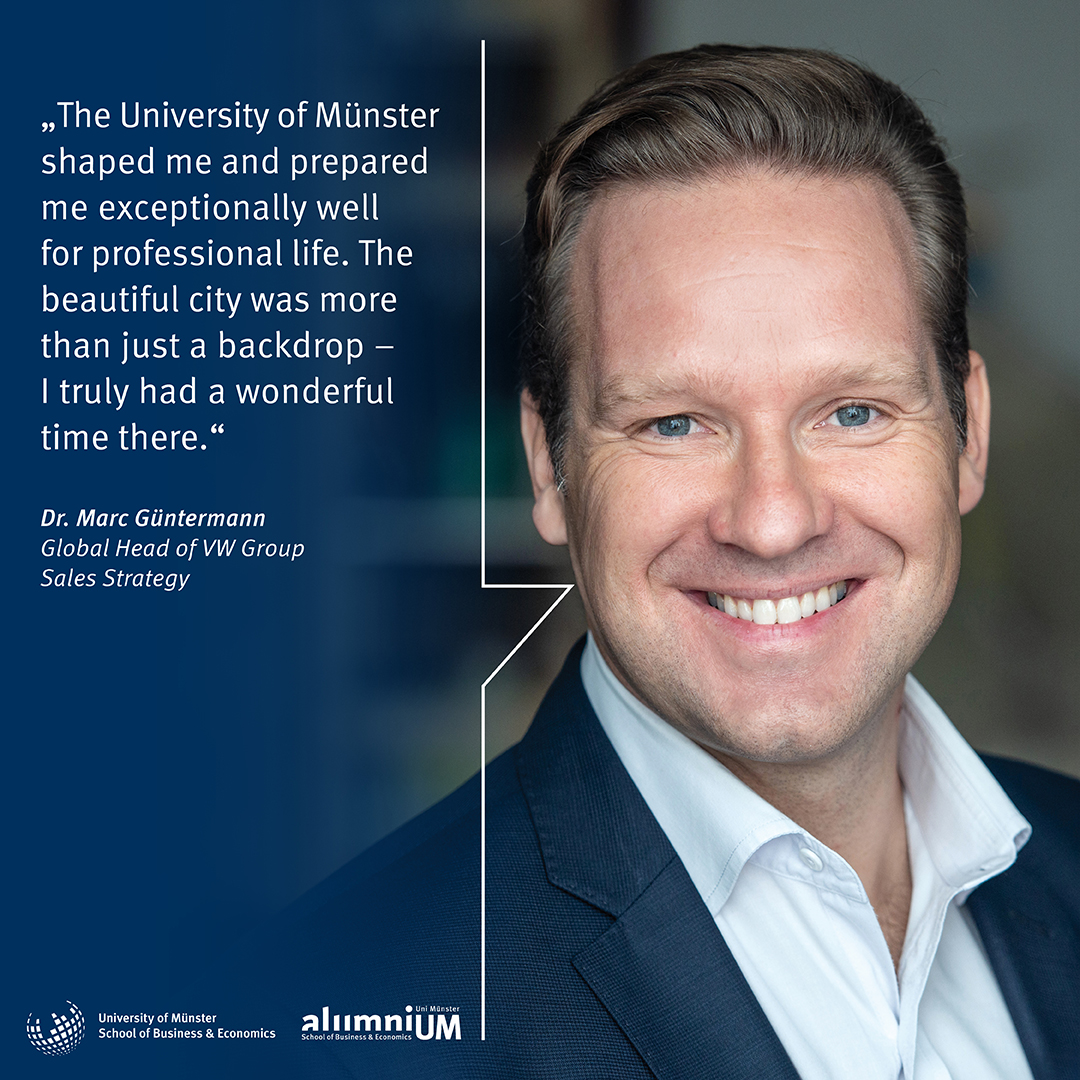
Dr. Marc Güntermann is Global Head of Sales Strategy at the Volkswagen Group and, in this role, has been responsible for the group’s global sales strategy since October 2025. With over 20 years of international experience, he has extensive expertise in the automotive industry. His work is characterized by a clear focus on sustainable business growth through data-driven decision-making and targeted organizational development.
Previously, Dr. Güntermann held various senior positions within the Volkswagen Group and Audi AG, including roles in Sales and After-Sales as well as Strategy and Transformation in Germany and North America. He studied Business Administration (Diplom-Kaufmann) at the University of Münster. He also earned his doctorate from Steinbeis University Berlin (Dr. rer. oec.), with a dissertation on customer loyalty based on qualitative and quantitative research methods. In 2023, he completed the Senior Executive Programme at London Business School.
In the interview, Dr. Marc Güntermann talks about his international career within the Volkswagen Group, the role of data-driven sales strategies, and the experiences that shape his current leadership approach.
Mr. Dr. Güntermann, as Global Head of Sales Strategy at the Volkswagen Group, you are responsible for the company’s global sales strategy. What strategic challenges are you currently facing?
The most exciting challenge is certainly the high pace of change in the automotive industry. Over the past five years alone, we have seen new competitors entering the market, AI solutions at customer interfaces, volatile global trade conditions, and new mobility offerings—alongside the ongoing transformation of the entire industry toward e-mobility. And it is foreseeable that the speed of change will continue to increase. In such an environment, it is important to have a clear strategic vision and align actions accordingly. At the same time, the framework conditions must be continuously analyzed so that necessary adjustments can be made quickly. Accordingly, we think extensively in scenarios and probabilities. You need clarity regarding the target state, while maintaining flexibility in strategic options. At the Volkswagen Group, our strategy builds on a successful market position that distinguishes us from many competitors: strong brands and iconic products, millions of loyal customers, and a globally established dealer network. In my role, I am able to combine proven success formulas with new approaches. That is exactly what makes the role so appealing to me.
You have held various leadership positions at Volkswagen and Audi in Germany and North America. Which experiences have had the strongest influence on you?
I found it personally enriching to live abroad for several years. In Canada, I experienced a true immigration country and a society that is well prepared for people from different cultures. Experiencing being the newcomer yourself fundamentally changes your perspective on certain discussions. I can only recommend that anyone take such an opportunity if they can. Regarding professional experience, I think of a phrase I encountered during my studies in Münster: perspective determines insight. Its relevance was repeatedly reinforced while living abroad. For example, when you view new car sales from a German perspective, you think of customers who mostly configure their vehicle individually and then wait for production and delivery. In North America, I experienced that new cars are often purchased directly off the lot after a test drive. If something cannot be immediately experienced and taken away, it is less likely to be sold successfully. We therefore could not simply transfer German best practices to a different context. However, the default tendency is often to rely on familiar solutions. In my current role, I therefore seek very close exchange with our global sales companies and ensure that there is sufficient flexibility in local implementation of our strategy.
You advocate the approach “Data over Opinion.” What is the importance of data-driven decision-making from your perspective?
During my doctoral research, I learned that business practice and theoretically grounded solutions do not always align. I researched customer loyalty in authorized service workshops. The topic was considered highly relevant in practice, but decisions were mainly based on assumptions about customer behavior. I was able to identify key factors influencing loyalty that were hardly taken into account in practice—for example, whether a car owner has an emotional attachment to their vehicle and occasionally wants to do something good for it. This experience had a strong impact on me. Since then, I try to question opinions and proposals and understand whether they can be substantiated with data and what alternative explanations or solutions might exist. Current developments in artificial intelligence, in particular, open up new opportunities for analyzing such questions. At the same time, it is important to emphasize that the relevance of experience should not be underestimated. Experience directs attention to additional courses of action and cultural context. It helps identify which data may be relevant for a model and is also necessary for interpreting data. However, experience cannot replace data analysis.
Much of your career has been characterized by responsibility for transformation processes. What, in your view, makes transformation successful?
The term transformation describes how an organization is structurally and culturally changed in order to successfully implement a strategy. In a rapidly changing world, strategies are adjusted more frequently. As a result, the need for transformation increases and the term is used more often. I observe that the reasons for transformation and the desired future state of the organization are often not described clearly enough. However, transformation can only succeed if all stakeholders can understand it and actively support it. There is interesting research in this area on how transformation should be communicated in order to be successful—whether it should be framed more as a risk or more as an opportunity for those involved. The answer is clear: both aspects must be communicated credibly if organizational change is to succeed. Transformation should never be perceived as an end in itself or a passing trend, but rather as a necessary survival strategy that can and will be demanding. It therefore always requires clear, honest, and visionary communication.