


Alumni Story: Carolin Kremer Ebenau & Thorsten van der Velten
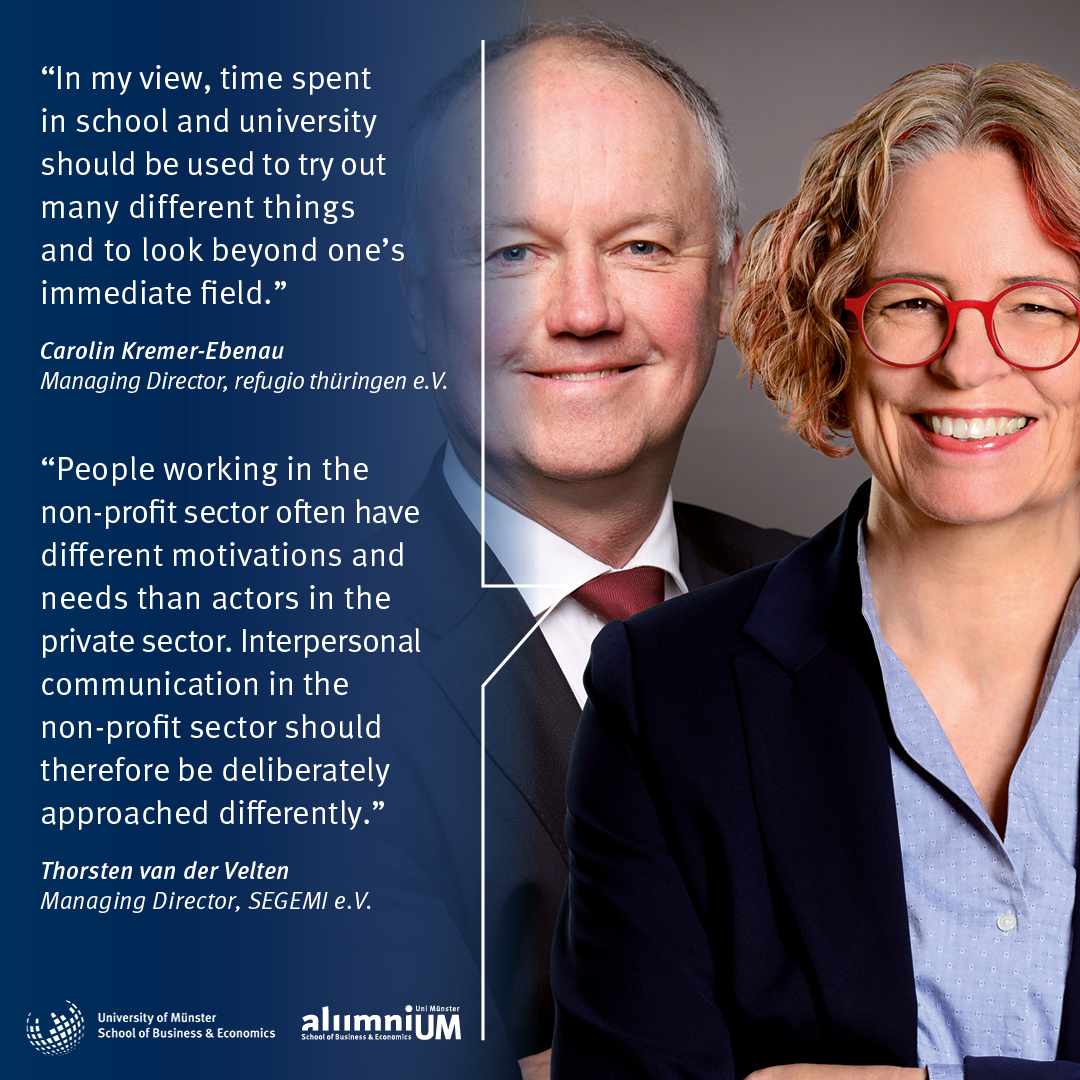
Carolin Kremer-Ebenau and Thorsten van der Velten are connected not only by their commitment to supporting people in difficult circumstances, but also by the fact that both began their professional careers at the University of Münster and were involved in the School of Business and Economics student council. While Carolin Kremer-Ebenau studied Economics, Thorsten van der Velten laid the foundation for his career with a degree in Business Administration. During this time, both gained valuable practical experience that would later shape their professional careers.
After graduating, their career paths initially took them in different directions: Carolin Kremer-Ebenau spent six years at PwC and subsequently more than two decades at EY, where she helped establish Business Development, worked on global market strategies and developed leadership programmes. Meanwhile, Thorsten van der Velten built an impressive career in retail and e-commerce, working for companies including the Otto Group, Tchibo and Beate Uhse Homeshopping, and later as a CEO and management consultant.
Recently, their paths crossed again: Since December 2024 (Thorsten van der Velten) and February 2025 (Carolin Kremer-Ebenau), both have been working as Managing Directors of non-profit organisations in Hamburg and Jena, respectively. The organisations operate Psychosocial Centres (PSCs) for refugees who have experienced war, persecution, torture and sexualised violence. After successful careers at large companies, both moved into the non-profit sector, driven by the conviction that they can use their experience, expertise and commitment to make a contribution to society.
In this interview with Carolin Kremer-Ebenau and Thorsten van der Velten, we learn more about their current work at refugio thüringen e.V. and SEGEMI e.V., how they experienced the transition from international corporations to the non-profit sector, which experiences from their time in the private sector continue to shape them today – and what memories they associate with Münster, the city where they both studied.
Ms Kremer-Ebenau, you have been heading refugio thüringen e.V. since the beginning of 2024, while Mr van der Velten took over as Managing Director of SEGEMI e.V. in December 2024. What are the main areas of focus in your respective roles – and what motivates you most about working for a non-profit organisation?
Thorsten van der Velten: My work focuses primarily on managing our office and securing our funding. The former includes all aspects of administration and organisation, managing colleagues and representing the association's interests externally. The latter primarily involves acquiring financial resources from government institutions at European, federal and state level, from funding organisations such as UNO-Flüchtlingshilfe, Amnesty International, various foundations and the German Television Lottery, as well as through donations from companies and individuals.
With my background in business administration and my many years of experience in medium-sized and large companies, I can make a contribution to a socially relevant and meaningful cause. This is enormously motivating for me.
Carolin Kremer-Ebenau: The job description at refugio was similar to what Thorsten has just outlined. The organisation was very well positioned administratively, but had grown significantly in recent years, particularly as a result of three very large EU projects. According to the board's instructions, my initial focus was supposed to be on addressing outstanding issues in what was already a rather painful process of organisational development. Just a few days after the end of my probationary period, however, this plan was abruptly overtaken by reality: Due to a completely unexpected change in the distribution of EU funding in Germany, we initially lost more than half of our budget. This meant crisis management and organisational development in opposite directions. Of course, this was not how I had imagined starting my new role. On the other hand, crisis management is also an exciting opportunity to shape things. And being able to help refugees in extremely difficult circumstances regain control over their everyday lives and, ideally, integrate well into Germany is a great source of motivation for me.
Both of you worked in the private sector and for large companies for many years before moving into the non-profit sector. Which experiences from that time continue to shape you most today? And is there anything you consciously want to do differently?
Carolin Kremer-Ebenau: In management consulting, you are not only working at the client interface but also operating at full speed as an internal service provider. Having a good grasp of complex interrelationships, as well as the ability and experience to keep the “big picture” in mind and develop actionable strategies, is extremely helpful to me today. I have certainly also been shaped by many years of working in multidisciplinary and multicultural teams and – long before the coronavirus pandemic – working from home. However, I did not make the move in order to consciously do things differently, but rather to continue developing professionally and personally through new challenges.
Thorsten van der Velten: My experiences during my studies and in the private sector have shown me that – alongside various external factors – expertise, methodological skills and interpersonal communication are particularly important for the success of organisations. The specific expertise required varies from task to task and from organisation to organisation, but it can and must also be acquired. Methodological skills such as team and self-organisation, decision-making and change management are more universal and can be applied in virtually any organisation. What has shaped me most, however, is the motto “All business is people’s business”: The success of every organisation essentially depends on its people. People in the non-profit sector often have different motivations and needs than those working in the private sector. Interpersonal communication in the non-profit sector should therefore be handled differently and consciously adapted to these circumstances.
The move from international corporations and consulting firms to social organisations is a major one. What motivated you to make this change – and what new challenges are you experiencing now in the non-profit sector?
Thorsten van der Velten: My main motivation was that, after many years in private-sector companies, I wanted to do something meaningful once again in the “autumn of my career” – to give something back to society, particularly in these extremely turbulent and challenging times. Another reason was certainly the prospect of a significantly better work-life balance, giving me more time for my children and hobbies.
For me, the biggest challenges in the non-profit sector have been the unfamiliar, less professional and sometimes inefficient conditions: volunteer boards and colleagues who are not always reliably available, colleagues whose motivation is hardly linked to personal career prospects or salary, and the resulting much greater need for appreciative communication.
Carolin Kremer-Ebenau: The better work-life balance has not worked out in my case, at least not yet – and, to be honest, I doubt that the social economy and non-profit organisations are the right sectors for pursuing such a goal. Like Thorsten, however, I also value the opportunity to do something professionally that has a meaningful impact on society. Since 2016, I have been involved in supporting refugees on a voluntary basis. While still at EY, I also completed further training as a systemic coach. In my role at refugio, all these experiences and interests have come together in a remarkable way. The biggest challenges? Politics and public administration rely on civil society to take care of people in precarious situations. At the same time, however, they make the work of non-profit organisations extremely difficult through excessive bureaucracy and constant mistrust. This has an impact on the people working in the non-profit and social sectors.
Both of you began your academic careers at the University of Münster – Ms Kremer-Ebenau studying Economics and Mr van der Velten studying Business Administration. Looking back, what do you associate with that time? And what advice would you give to today's students?
Carolin Kremer-Ebenau: Everyone has to find their own path, but in my view, school and university should be a time to try out different things and look beyond your own horizons! Looking back, I am extremely grateful that studying at the time was still relatively free and not overly structured. I would choose my specialisation in “Cooperation, in particular cooperatives” with Professors Bonus and Großekettler again at any time. I also have fond memories of two ski seminars and the first Harvard Business Cases seminar at FB04 – less so of the overcrowded lecture halls. In addition to studying Economics, I completed basic studies in History and Political Science, with a two-semester detour into Philosophy. I served as the AStA Social Affairs Officer on the supervisory board of the Studierendenwerk, worked as a student assistant at the Faculty of Medicine and co-founded the Symposium Oeconomicum Muenster. And, which I can hardly believe in retrospect, I still had the time and energy for student orchestras, trips to the Werse and Aasee, and many, many parties. My AIESEC internship in Katowice, which took place before the fall of the “Iron Curtain”, also had a major influence on my subsequent life – and if I thought about it for longer, I would probably come up with many more memories.
Thorsten van der Velten: Looking back, my time at the University of Münster was very formative and filled with wonderful memories. I not only learned a great deal academically, but also developed personally through my involvement in various university committees (student council, faculty committees, AStA...). I also enjoyed student life in one of Germany's most beautiful cities and made many friendships, some of which still exist today.
My advice to today's students would therefore be: Take your studies seriously, get involved in committees or associations, and enjoy your time at the University of Münster!